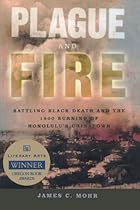
Plague and Fire: Battling Black Death and the 1900 Burning of Honolulu's Chinatown
| Author | : | |
| Rating | : | 4.57 (572 Votes) |
| Asin | : | 0195311825 |
| Format Type | : | paperback |
| Number of Pages | : | 256 Pages |
| Publish Date | : | 2015-08-04 |
| Language | : | English |

DESCRIPTION:
James C. Mohr is College of Arts and Sciences Distinguished Professor of History at the University of Oregon.
Mohr tells this gripping tale largely through the eyes of the people caught up in the disaster, from members of the white elite to Chinese doctors, Japanese businessmen, and Hawaiian reporters. They resisted intense pressure from the white community to burn down all of Chinatown at once and instead ordered a careful, controlled burning of buildings where plague victims had died. Next to the attack on Pearl Harbor in 1941, the Chinatown fire is the worst civic disaster in Hawaiian history. At the heart of the narrative are three American physicians--the Honolulu Board of Health--who became virtual dictators when the government granted them absolute control over the armed forces and the treasury. Some 5000 people lost their homes and all their possessions and were marched in shock to detention camp
. Copyright © Reed Business Information, a division of Reed Elsevier Inc. All rights reserved. He also illuminates the issues that arise when civil rights and public safety clash. 25 b&w photos. Mohr charts these events with precision. The pictures of the aftermath of the Chinatown fire and the mass disinfections of Japanese and Chinese residents are a striking and valuable addition. But some readers will want more scientific information about the plague, and Mohr's generally commendable thoroughness is sometimes overtaken by repetitive details. Emphasizing the political and social aspects of the battle ag
"A complex collision of science, politics & culture" according to Harry Eagar. When the plague came to Kahului on Maui in 1900, the little port village was burned down without fuss, and the sickness was ended.It was very different in Honolulu on the more populous (though still small) island of Oahu, where the disease arrived somewhat earlier. In "Plague and Fire," University of Oregon historian James Mohr has done a masterly job of sorting out a complicated situation.The world was -- again -- in the grip of a pandemic in the late 1890s, and the disease hit Hawaii just in the middle of two extraordinary changes, one political, one scientific.Hawaii had been annexed by the U. A well-balanced reassessment of the desperate measures implemented in response to a public health crisis D. Cloyce Smith On a single day in 1900, over 5,000 Honolulu residents--nearly all of them living in the Chinatown section--lost their homes and belongings in a fire that swept through the district and destroyed a number of landmarks (including the venerated Kaumakapili Church). Although health officials set the fire, they had meant to contain it to a small set of hovels that had been home to a recent victim of a plague epidemic. The winds shifted and the church steeple caught fire, acting as a torch and sprinkling embers throughout the entire neighborhood. Miraculously, not a single person died in the fire.Fol. Massachusetts Reader said Hawaii, History, Medicine, & Law collide in Gripping Tale. The Boston Globe gave it a rave review (Nov. 18, "Hawaii, History, Medicine, & Law collide in Gripping Tale" according to Massachusetts Reader. The Boston Globe gave it a rave review (Nov. 18, 200Hawaii, History, Medicine, & Law collide in Gripping Tale Massachusetts Reader The Boston Globe gave it a rave review (Nov. 18, 2004) and it's well deserved. Recommended reading for anyone interested in U.S. history, medicine, public health, or legal history. Travelling to Hawaii? Take this along and see a very different side of paradise!. ) and it's well deserved. Recommended reading for anyone interested in U.S. history, medicine, public health, or legal history. Travelling to Hawaii? Take this along and see a very different side of paradise!. 00Hawaii, History, Medicine, & Law collide in Gripping Tale Massachusetts Reader The Boston Globe gave it a rave review (Nov. 18, 2004) and it's well deserved. Recommended reading for anyone interested in U.S. history, medicine, public health, or legal history. Travelling to Hawaii? Take this along and see a very different side of paradise!. ) and it's well deserved. Recommended reading for anyone interested in U.S. history, medicine, public health, or legal history. Travelling to Hawaii? Take this along and see a very different side of paradise!